Friday, July 2, 2010

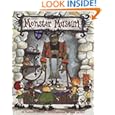
Book Review 2 - Genre 3 - Monster Museum by Marilyn Singer


Bibliography -

Singer, Marilyn. 2001. Monster Museum. Ill. By Gris Grimly. New York: Disney Hyperion Books. ISBN 9781432121008.

Plot Summary –

Monster Museum is a single poet compilation anthology of 21 poems and includes a “glos-scary.” The first poem sets up the premise of children going on a tour of the monster museum. The following poems are descriptions of various exhibits in the museum, and the final poem is a farewell to those who visited the monster museum. After the poems is a glossary that gives information on each of the monsters, scary things, and mythical creatures mentioned in the exhibits.

Critical Analysis -

Monster museum is a great collection to share anytime but particularly around Halloween. While the reader will enjoy the absurdity of the poems, lots of enlightening information is also presented. The reader learns much about the various creatures not only in the glossary but in the poems themselves. For example, the poem on Frankenstein points out that the creator of the monster is Frankenstein, and that the monster had no name of his own. While most poems give accurate information, one is suspect. The poem on the unicorn says, “A lizard with wings is a horror, /A stallion with wings is a beaut. /A snake with a horn is a nightmare, /A mare with a horn is just cute” (p. 31). Here the poem implies that a unicorn flies. This is not accurate. The winged horse from Greek mythology is known as Pegasus and is not a unicorn. This small gaffe does not take away all the laughs.

Pardon the previous playing with rhymes, but Singer does the same in this collection. Mostly the rhymes are entertaining and creative. The poem on the Blob has a very interesting rhyme and use of language. It plays with variations of the word job and continues the rhyme with the new word. Only one rhyme falls a little flat; it is in the poem, “The Ogre, The Troll” when she rhymes “them” with “them.” Besides rhyme, Singer also uses a considerable amount of alliteration, repetition, and interesting line structures to enhance her poems. In the poem “Dr. Jekyll and Mr. Hyde”, she writes the poem as dialogue between the two who are the same person. It makes for an interesting format. Her use of language and structure create a not too spooky kooky collection of amusing poems.

This book of poems is illustrated by Gris Grimly (a pseudonym for Steven Soenksen) using watercolors. The illustrations are perfectly paired with the poems. Grimly starts off in the welcoming area of the museum with the children and their guide and moves through each exhibit with exciting and hilarious images. The characters are all exaggerated in one way or another which adds to the fun. The children on the tour for example have pencil thin legs and overly large feet which is a comical combination. Each page is loaded with visual extras to explore just as one would find at a real museum exhibit. Medusa’s beauty parlor is quite fascinating with the wide range of shears and accessories. And in the end, the monsters go home on the school bus with the children symbolizing the knowledge the children take with them after visiting the museum. Every excellent museum strives to leave a lasting impression on their guests and Monster Museum is no exception.

Review Excerpts -

Publishers Weekly - "Among the season's best creature features."

School Library Journal - "This fresh, witty book will be popular for not-so-scary storytimes, as well as independent reading."

Kirkus Review - "Singer's poems are lively and humorous..."

Connections -

*Share the poems during October and use as part of a Halloween display.

*For fun, play the Disney recording of the song "Monster Mash" and have the children listen to identify which monsters appear in both the museum and the song.

*For older children, have them do some Internet research and see how accurate her portrayal of the monsters are.

*In groups, have the children research other monsters, scary things, or mythological creatures and write poems for their own exhibits in the Monster Museum.

*Have students compare/contrast the illustrations in other books by Gris Grimly:

  • Gris Grimly’s Wicked Nursery Rhymes ISBN 9780972938877.
  • Edgar Allen Poe’s Tales of Mystery and Madness by Edgar Allen Poe, ISBN 978068984837.
  • The Dangerous Alphabet by

Book Review 1 - Genre 3 - Arithme-Tickle: An Even Number of Odd Riddle-Rhymes by Patrick J. Lewis


Bibliography -

Lewis, Patrick J. 2002. Arithme-Tickle: an even number of odd riddle-rhymes. Ill. By Frank Remkiewicz. Orlando, FL: Harcourt Books. ISBN 9780152058487.

Plot Summary -

This individual poet compilation of poems makes math fun. J. Patrick Lewis includes 19 poems all dealing with numbers. Most of them are rhyming word problems to solve, but a few are just plain fun using numbers. The answers are included in small print and inverted in case the reader gets stumped.

Critical Analysis -

Arithme-Tickle: An Even Number of Odd Riddle-Rhymes is an engaging collection of poems. First of all, solving the riddle is always appealing to a reader. The brain instinctively begins to solve the puzzle as it reads. Not only does it appeal to children, it also engages the adult reader. For example, at first I was stumped by the title. It mentions, "An Even Number..." When looking at the table of contents, there are 19 named poems. That's an odd number, but when looking at the individual poems only 16 are "odd riddle-rhymes." The three remaining ones are not riddles; they are poems using numbers in an interesting way with nothing to solve. While the entire collection is not riddles, they all involve numbers.

Most of the poems use rhythm and rhyme which is in keeping with the riddle tradition. This helps them to be memorable. Some of the poems rhyme more than others. Lewis does not force the rhyme for rhyme sake, but uses it to enhance the poem. Most of the rhythm is written in iambic meter form. This creates a sing-song beat that further appeals to the reader. Other sound devices Lewis uses are alliteration and parallel structure. These are not widely used, but are effective when selected. His language is generally creative and sometimes surprising. In one poem, he uses the invented word "poo-poo-pee-doo" as the name for a poodle. For younger children, this may be a problem because many of them may hear it as "potty talk." I think most of them would probably giggle, but some may be a little surprised.

Overall, the poems are quite hilarious and the illustrations add to the humor. The illustrations are bold and bright in watercolor and prisma color pencils on Bristol board. Each illustration adds to the overall effect of the poem. The faces for the most part are jubilant and only deviate when it is referenced in the poem. For example on page 19 when Farmer Flynn's sheep die, he is shown as crying. On page 20-21 is a poem entitled "How many coconuts" in which the illustration is absolutely necessary to solve the riddle. Also, the poems are written on appropriate types of paper. The poem about a mailman is written on pictures of postcards whereas most of them are on pictures of spiral notebook paper. Two are on stationary which are poems written between friends, and the last one is on a drawn banner with cheerleaders holding it up to celebrate the readers completion of the book. The poems and illustrations are intricately linked. This is a great collection of poems to encourage kids to enjoy math.

Review Excerpts -

Publishers Weekly - "...offers a host of clever math riddles with titles like "Finger Play" (which teaches a nifty trick for multiplying by nine) and "Your Average Cow,"

Booklist - "The humorous tone of the rhyming text and the variety of puzzles will definitely add to the fun for those who are ready for a challenge."

School Library Journal - "A new book by a wordplay master always adds up to fun."

Connections -

*Cross curricular with math. The children can read and solve a fun riddle poem to reinforce a recently covered math concept.

*Using their favorite poem as a model, the children can create their own rhyming riddle poems and have their classmates try to solve them.

*Other math picture books to use:

· A Pair of Socks: Matching by Stuart J. Murphy and Lois Ehlert (HarperCollins, 1996, ISBN: 0-060-25879-9). This book supports young students in learning about pairs, patterns and differences.

· Leaping Lizards by Stuart J. Murphy and Joann Adinolfi (Harper Collins, 2005, 0-060-00130-5). This books supports counting by fives.

· How Many Birds Flew Away: A Counting Book with a Difference by Paul Giganti, Jr. (Greenwillow, 2005, ISBN: 0-060-00762-1). This book uses counting and subtracting.

· Math Potatoes: Mind-stretching Brain Food by Greg Tang (Scholastic, 2005, ISBN: 0-439-44390-3). This book uses math strategies for young children also uses riddles like Arithme-Tickle.

Saturday, June 26, 2010

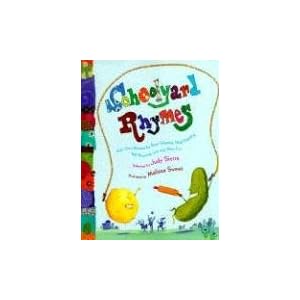
Book Review 3 - Genre 2 - Schoolyard Rhymes: Kids' Own Rhymes for Rope Skipping, Hand Clapping, Ball Bouncing, and Just Plain Fun by Judy Sierra

Bibliography -

Sierra, Judy. 2005. Schoolyard rhymes: Kids' own rhymes for rope skipping, hand clapping, ball bouncing, and just plain fun. Ill. by Melissa Sweet. New York: Alfred A. Knoft. ISBN 9780375825163.

Plot Summary -

A collection of easy to remember schoolyard rhymes from various time periods and various countries. These kid create rhymes have been past down from generation to generation. They are created for jump skipping, hand clapping, ball bouncing, and just plain fun as the subtitle states.

Critical Analysis -

These entertaining rhymes are fun and cute, but some need to be considered for age appropriateness. All are very rhythmic and loaded with rhyme which helps them to be memorable. Some of them took me on a trip down memory lane. I can remember vividly hand clapping to "The Lady with the Alligator Purse." As I read it again, I realized that it is a frightening story about a lady kidnapping a baby. I never caught this as a child when I was hand clapping it. Another one which tickled my memory was "Roses are red/Violets are blue." I can remember going on endlessly with my friends trying to make up new lines for this old favorite.

Some of these schoolyard rhymes are not meant for younger children and others are total nonsense. On page 3, there is one about Miss Mary smoking a pipe. Some may have a problem with this, but it is overall meant to be rhyming nonsense and does not make smoking look fun. On pages 28-29, there are several that talk about girlfriend-boyfriend kissing. These probably should not be shared with small children especially the one in which a girl throws her boyfriend over her Granny's house without his underpants. An example of total nonsense is the one on page 7 about the judge. The illustration for this one makes the rhyme so much funnier because the reader can easily visualize what the rhyme is saying even though it is nonsense.

Concerning the illustrations, they are fantastic. Melissa Sweet uses watercolor and fabric collages to rope in the reader. On page 2, the banana, with his peeling partially split and wearing fudge topping and a cherry hat, is skipping rope and playing the piano. This picture alone will make the reading laugh, but it doesn't end there. Every page has rib-tickling pictures that add to the amusement of the rhymes. As previously stated, some illustrations help to make sense out of the nonsense of the rhymes. On page 17, the rhymes are about bubble gum and each one appears in a large pink circle of bubble gum inviting the reader to blow bubbles with their gum. Whether an adult reader uses this book to reminisce their childhood or new children are introduced to this fun packed book, it is an entertaining addition to any library.

Review Excerpts -

School Library Journal - "Sierra has selected some of the funniest and most memorable schoolyard rhymes available..."

Booklist - "Sweet's comical, mixed-media art adds to the wackiness of the rhymes, with jump ropes commanding a prominent position..."

Connections -

*Use to teach rhythm and rhyme.

*Have students say and do the motions with one like "Anna Banana" and then have them make up their own variations using different instruments and song titles.

*Have students select their favorites, decide what motion to do with it (like skipping rope, hand clapping, etc.) and then perform it for the class or even for a younger group of children.

*Share other schoolyard rhyme books like:

· Anna Banana: 101 Jump Rope Rhymes by Joanna Cole and illustrated by Alan Tiegreen. ISBN 9780688088095.

· Hand Clap! by Sara Bernstein. ISBN 9781558504264.

· Hopscotch, Hangman, Hot Potato, & Ha Ha Ha by Jack Maquire. ISBB 9780671763329.

Book Review 2 - Genre 2 - Cindy Ellen: A Wild Western Cinderella by Susan Lowell

Bibliography -
Lowell, Susan. 2000. Cindy Ellen: a wild western Cinderella. Ill. by Jane Manning. New York: HaperCollins Children's Books. ISBN 9780064438643.

Plot Summary -
In this Wild West version of the classic fairy tale Cinderella, a young cowgirl named Cindy Ellen lives with her snaky old stepmother and her two stepsisters on her father's ranch. Cindy Ellen is so good that she makes her stepsisters look bad, so her stepmother begins to mistreat her by making Cindy Ellen do all the chores especially the difficult and dirty ones. Joe Prince, son of a wealth rancher, holds a rodeo and square dance to find him a bride. At first Cindy Ellen cannot go because she is dirty and has no way to get there. Then her pistol packing fairy godmother shows up and gets her ready to go with the use of her magic dust and gives Cindy Ellen the expected warning to be home by midnight. Cindy Ellen attends both the rodeo and square dance with Prince Joe falling in love with her. She must leave by midnight but one of her diamond spurs falls off and Prince Joe finds it. He goes all through the territory trying the spur on every girl's foot looking for the love of his life. Finally, he puts it on Cindy Ellen and they marry living happily ever after.

Critical Analysis -
This version of an old traditional tale faithfully follows the plot development of Cinderella with an American Wild West motif. It is an example of a modern day fractured fairy tale in that it is a parody of Cinderella and has a known author. All the traditional Cinderella elements have been replaced with Western elements, for example, the ball becomes a rodeo and square dance, the glass slipper becomes a diamond spur and the magic wand becomes a magic pistol. The best element is the transformation of the language. Lowell captivates the reader with her genuine use of the American West dialect. The reader laughs out loud when hearing language like "orneriest" and "gumption." Additionally her colorful use of similes and metaphors are particularly entertaining. Some of my favorite ones are "meaner than a rattlesnake," "spitting image," "hissed the stepmother," and "eating his heart out." All of which adds to the authentic representation of the old American West.

The illustrations also add an interesting dimension to this tale. One way is that they are bright fun colors with modern clothing. The pictures give the reader the idea that it is an old story because everyone travels by horse, wagon, or carriage. There are no modern items, yet the clothing is more typical of what the characters would wear today than in the old West. Another way the illustrations add an interesting dimension is in the facial expressions. They are priceless. When the stepsisters are being mean to Cindy Ellen, they have small beady eyes and eyebrows that shoot straight up in a menacing fashion. When Cindy Ellen is exhibiting her daredevil grin, she is cutting her light blue eyes to the side with her cute dimples on display. The facial expressions are irreplaceable.

One illustrative element that seems out of place is the dress Cindy Ellen wears to the square dance. She is wearing a long full dress with ornate flowering on long sleeves and large red flowers in her hair. It looks more like the dresess worn by dancers from Mexico than by those at a Western square dance. However, a careful reading of the text reveals what might have sparked this possible deviation. The fairy godmother tells Cindy Ellen, "Maybe si, maybe no" Perhaps Manning's imagination to select the Spanish style outfit was prompted by the use of a Spaonish word. Whatever the reason, it is a wonderful illustration that adds an interesting dimension to this marvelous version of an old favorite.

Review Excerpts -
Kirkus review - "Bright, stylish...Manning tricks out her characters in dazzling modern cowboy dress."

Horn Book -
"Expressive regional turns of phrase and exuberant full-color comic illustrations in skewed perspectives place the action squarely in the dry desert of the West."

Winner of the Storyteller Award from the Western Writers of America.

Connections -
*Before reading Cindy Ellen: A Wild Western Cinderella, have the children brainstorm everything they know about the traditional fairy tale Cinderella. If they are not familiar with it, then read it to them first. Then make a chart showing how they are similar and different.

*
Discuss with the children the American West dialect.

*
After reading the tale, compare and contrast this Western Cinderella tale which has a female protagonist with one that has a male protagonist like Bubba, the Cowboy Prince by Helen Ketterman ISBN 9780590255066.

*For older children, use Bubba, the Cowboy Prince to demonstrate reader's theater, and then put the children in groups to write their own scripts for Cindy Ellen: A Wild Western Cinderella.

Friday, June 25, 2010

Book Review 1 - Genre 2 - Star Boy by Paul Goble


Bibliography -
Goble, Paul. 1991. Star Boy. New York: Aladdin. ISBN 9780687914993.

Plot Summary -
A young Blackfoot girl falls in love with Morning Star of the Sky World. His father is Sun and his mother is Moon. He marries the young Indian girl and takes her to live in Sky World where they have a son named Star Boy. The young girl is very happy in her new home but disobeys her mother-in-law and is banished back to earth. The baby Star Boy returns to earth with his mother with a scar on his face because of his mother's disobedience. The young girl is not happy on earth and dies returning to Sky World as Evening Star. Her son, Star Boy grows up on earth and falls in love with the chief's beautiful daughter, but he must complete a journey to win his bride. The journey takes him to the Sky World, and he brings back to earth the sacred knowledge of the Sun Dance.

Critical Analysis -
Star Boy by Paul Goble, a Native American tale from the Blackfoot people, is a captivating story which has depth of understanding through cultural representation and universal themes. The Blackfoot people are of the northern Great Plains, and this tale stays true in its representation of their culture in text and illustrations. The text explains in detail how and why the Blackfoot people celebrate the Sun Dance. While the customs are primarily focused on the Native American culture, some Christian influences crept into the Native American traditions. For example, the story of the young Indian girl who is told that she may dig anywhere but where the pink flowers are located is very reminiscent of the Biblical account of the Garden of Eden. In both stories, the girls are punished for their disobedient actions, and the punishment extends to others.

Also, cultural references are portrayed in the illustrations which are mostly in earth tone colors like dark red, shades of brown, dark blue, dark green, and plenty of gold. These colors are typically associated with Native American culture. Additionally, the illustrations are used to show the reader the different settings of the tale which are the earth below and Sky World. When the characters are in Sky World, the pages are bordered with the same designs that are generally painted on the Blackfoot tipis. Each tipi has a design painted on it to represent their vision of the Sky World. This motif not only reflects the cultural heritage of the tale but adds to the reader's understanding of the setting.

While in Native American Indian cultures chiefs are generally men, the societies are matriarchal in which property rights and chief selections are through the woman's lineage. As a result, women are frequently portrayed as strong characters. Goble stays true to this cultural aspect. Moon, Morning Star's mother, is a strong character in that she gives Evening Star the digging instructions to follow. Evening Star is strong in that she selects her husband and accepts her punishment for her disobedience. Likewise, the chief's daughter's strength is in her selecting her husband and then explaining to him what he must do to win her in marriage. In this tale, the woman are making the decisions and giving the instructions.

Besides cultural representation, Goble uses universal themes to add depth to this exceptional tale. The moral theme of obedience has previously been discussed, but the basic human nature of curiosity is also wrapped up in this theme. It is the young Indian girl's curiosity that led to her disobedience and disobedience ends in loneliness, sadness, and isolation. The illustration of the funeral scene dramatically displays this theme. In contrast to all of the other pages, the funeral scene is plain and dark with a desolate landscape. The only one attending her funeral is her son, Star Boy. He is the only one of his kind, half earth and half Sky World. Her sad longing to return to Sky World and his isolation due to his unique parentage is undeniable in this illustration.

Another universal theme is the journey or quest to secure the love of your future mate. Star Boy must travel to the place of the Sun and seek his grandfather's approval to marry the chief's daughter. He is poor and ugly before his journey, but after getting his grandfather's approval, he returns to earth handsome and rich as a sign of his approval. Interestingly, Sun tells his grandson that "a pure woman shall live a long time." Star Boy's mother did not live a long life on earth, so the message here is to live a pure life. This traditional tale by Paul Goble has many levels of understanding to explore. He expands the reader's knowledge of the Blackfoot culture by giving an accurate portrayal, and he invites all to enjoy with his use of universal themes.

Review Excerpts -
Booklist (Starred review) - "A considered, reverent, and eye-catching rendition of an important native American legend."
Publishers Weekly - "Illustrated by elegant, brilliantly colored pictures in the Caldecott Medalist's recognizable style, the pictures...recreate ancient days among the Blackfeet Indian."

Connections -
*Other books by Paul Goble can be used to discuss his uniquely creative illustrations:
  • The Girl Who Loved Wild Horses ISBN 9780689716966.
  • Buffalo Woman ISBN 97806899711091.
  • Dream Wolf ISBN 9780689815065.
  • Her Seven Brothers ISBN 9780689717307.
*Compare and contrast cultures of other Native American tribes with the Blackfoot people.
*Use this tale to teach symbolism and/or personification.
*Two poems are listed at the end of the tale that relate to the story. Have older children find examples of poems that match other Native American traditional tales.


Tuesday, June 15, 2010

Book Review 3 - Genre 1 - Show and Tell: Exploring the Fine Art of Children's Book Illustrations by Dilys Evans

Bibliography -
Evans, Dilys. 2008. Show and tell: Exploring the fine art of children's book illustrations. ISBN 9780811849715.

Plot Summary -
Realizing a need to have universal vocabulary in which to discuss the fine art in children's books, Dilys Evans explores some of the best children's books to develop this vocabulary and to explain how the illustrations qualify as fine art. She selects a wide variety of illustrators who are diverse in styles, techniques and content. The twelve illustrators that she showcases are Hilary Knight, Trina Schart Hyman, Harry Bliss, David Shannon, Bryan Collier, Paul O. Zelinsky, Petra Mathers, Brian Selznick, David Wiesner, Betsy Lewin, Denise Fleming, and Lane Smith.

Critical Analysis -
While Evan's desire is to create a universal vocabulary to discuss fine art in children's books, she also has the expertise to accomplish the goal. She is a past art director for Cricket magazine, an accomplished author, adviser for Caldecott committees, and has worked with some highly acclaimed children's book illustrators. Additionally, in 1980 she founded The Original Art, an annual exhibition in New York featuring the best of children's book illustration of the year. She is uniquely qualified to take on this challenge.

The format for her book is the exploration of twelve contemporary illustrators of children's books. She looks at each illustrator separately and gives in-depth details on their life, influences in their art, chronology of their artistic career and a thorough explanation of the illustrator's individual artistic style. After reading this book, the reader has a complete understanding of how illustrations complement and enhance the text of a story. Page 125 offers an excellent example of the depth of her explanations. There she shows photographic images to support her written explanation of Denise Fleming's use of "pulp painting." Evans has masterfully created a book that will be a must have for librarians and anyone else who has a desire to learn more about the world of fine art in children's books.

Review Excerpts -
School Library Journal (starred review) - "Who better to 'show and tell' how children's book illustrators work their magic than Evans, whose life mission has been to advocate for their status as fine artists."
Booklist - "This attractive title will be a boon for librarians, teachers, students, and anyone else who wants to learn to look at and talk about the art in children's books, as well as better understand the stories behind the pictures."

Connections -
*
Share children's books by illustrators showcased in the book. Then share what Show and Tell: Exploring the Fine Art of Children's Book Illustrations says about the illustrator and his/her style. Discuss.
*After exposing children to stylistic descriptions of an illustrator and sharing a book by that illustrator have the children try the artistic style for themselves. Be sure to emphasize that the goal is not to create something "perfect," but to experiment and explore a particular style of art.
*Use Show and Tell: Exploring the Fine Art of Children's Book Illustrations to introduce children to the vocabulary necessary to discuss fine art in children's books.
*For older children, use Show and Tell: Exploring the Fine Art of Children's Book Illustrations to conduct research o contemporary children's book illustrators.

Book Review 2 - Genre 1 - Bebe Goes Shopping by Susan Middleton Elya


Bibliography -
Elya, Susan Middleton. 2008. Bebe Goes Shopping. Ill by Steven Salerno. Orlando: Harcourt, Inc. ISBN 9780152061425.

Plot Summary -
In this story, Mama negotiates the challenges of taking Bebe to the grocery store. Being a very young child, he is extremely curious about his surroundings, and the exploration of his curiosities makes challenges for Mama. Her shopping is continually interrupted by rescuing Bebe from his explorations, so she decides to give him a treat to eat to keep him busy. It is a day of wonder and excitement for Mama and Bebe.

Critical Analysis -
This active and engaging story is one to which both adult and child can relate. All mothers and children have experienced the busyness and wonder that a trip to the grocery store can hold. Inventive rhyme schemes are created using English to English words, Spanish to Spanish words and Spanish to English words. An example of Spanish to English words rhyming is "Por favor" rhyming with "floor". This makes for intriguing word play. This is an excellent book to share with children especially those who maybe learning English or to expose non-Spanish speakers to the Spanish language. All of the Spanish words are in bold print which focuses the reader's attention onto them. The glossary is a wonderful support for non-Spanish speakers to help with the meaning and correct pronunciation of the Spanish words.

The illustrations are drawn by Steven Salerno using gouache, watercolors, colored inks and colored pencils on French Arches 260 lb hot pressed watercolor paper. The drawings are larger than life and filled with bright colors. The people are drawn in very interesting ways. The head are proportionally larger than the bodies and oblong in shape which make them resemble no particular group. While the book uses Spanish words, the characters do not look particularly Spanish with the possible exception of the Senora who has some stereotypical features. The characters are brown in skin tone but culturally indistinct in features. Mama for example has crown shaped lips and a wide nose that could suggest African heritage. She also has almond shaped eyes that could suggest Asian heritage. While the book focuses on Spanish culture, the characters could fit into other cultural stories. That helps bring children from different cultures into the story.

Review Excerpts -
Publishers Weekly (Starred review) - "This delightful tale turns an everyday chore into a lively adventure, brimming with entertainment and enjoyment for all."
Booklist (Starred review) - "Introducing a young child to Spanish has never been as attractive as in this shopping romp...Fantastico!"
School Library Journal - "Warm and engaging."
Kirkus Review - "Will leave readers smiling."
Parenting Magazine - best book of the year

Connections -
*
Other books reinforcing Spanish:
  • Weeks, Sarah. Counting Ovejas. ISBN 0689867506.
  • Elya, Susan Middleton. Bebe Goes to the Beach. Ill. Steven Salerno. ISBN 0152060006.
*Share nursery rhymes and children's poems that are in English and Spanish:
  • "Los Politos" = "Little Chickens"
  • Other examples can be found at www.mamalisa.com which include songs, MP3s, MIDI, and videos.