Friday, June 25, 2010

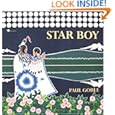
Book Review 1 - Genre 2 - Star Boy by Paul Goble


Bibliography -
Goble, Paul. 1991. Star Boy. New York: Aladdin. ISBN 9780687914993.

Plot Summary -
A young Blackfoot girl falls in love with Morning Star of the Sky World. His father is Sun and his mother is Moon. He marries the young Indian girl and takes her to live in Sky World where they have a son named Star Boy. The young girl is very happy in her new home but disobeys her mother-in-law and is banished back to earth. The baby Star Boy returns to earth with his mother with a scar on his face because of his mother's disobedience. The young girl is not happy on earth and dies returning to Sky World as Evening Star. Her son, Star Boy grows up on earth and falls in love with the chief's beautiful daughter, but he must complete a journey to win his bride. The journey takes him to the Sky World, and he brings back to earth the sacred knowledge of the Sun Dance.

Critical Analysis -
Star Boy by Paul Goble, a Native American tale from the Blackfoot people, is a captivating story which has depth of understanding through cultural representation and universal themes. The Blackfoot people are of the northern Great Plains, and this tale stays true in its representation of their culture in text and illustrations. The text explains in detail how and why the Blackfoot people celebrate the Sun Dance. While the customs are primarily focused on the Native American culture, some Christian influences crept into the Native American traditions. For example, the story of the young Indian girl who is told that she may dig anywhere but where the pink flowers are located is very reminiscent of the Biblical account of the Garden of Eden. In both stories, the girls are punished for their disobedient actions, and the punishment extends to others.

Also, cultural references are portrayed in the illustrations which are mostly in earth tone colors like dark red, shades of brown, dark blue, dark green, and plenty of gold. These colors are typically associated with Native American culture. Additionally, the illustrations are used to show the reader the different settings of the tale which are the earth below and Sky World. When the characters are in Sky World, the pages are bordered with the same designs that are generally painted on the Blackfoot tipis. Each tipi has a design painted on it to represent their vision of the Sky World. This motif not only reflects the cultural heritage of the tale but adds to the reader's understanding of the setting.

While in Native American Indian cultures chiefs are generally men, the societies are matriarchal in which property rights and chief selections are through the woman's lineage. As a result, women are frequently portrayed as strong characters. Goble stays true to this cultural aspect. Moon, Morning Star's mother, is a strong character in that she gives Evening Star the digging instructions to follow. Evening Star is strong in that she selects her husband and accepts her punishment for her disobedience. Likewise, the chief's daughter's strength is in her selecting her husband and then explaining to him what he must do to win her in marriage. In this tale, the woman are making the decisions and giving the instructions.

Besides cultural representation, Goble uses universal themes to add depth to this exceptional tale. The moral theme of obedience has previously been discussed, but the basic human nature of curiosity is also wrapped up in this theme. It is the young Indian girl's curiosity that led to her disobedience and disobedience ends in loneliness, sadness, and isolation. The illustration of the funeral scene dramatically displays this theme. In contrast to all of the other pages, the funeral scene is plain and dark with a desolate landscape. The only one attending her funeral is her son, Star Boy. He is the only one of his kind, half earth and half Sky World. Her sad longing to return to Sky World and his isolation due to his unique parentage is undeniable in this illustration.

Another universal theme is the journey or quest to secure the love of your future mate. Star Boy must travel to the place of the Sun and seek his grandfather's approval to marry the chief's daughter. He is poor and ugly before his journey, but after getting his grandfather's approval, he returns to earth handsome and rich as a sign of his approval. Interestingly, Sun tells his grandson that "a pure woman shall live a long time." Star Boy's mother did not live a long life on earth, so the message here is to live a pure life. This traditional tale by Paul Goble has many levels of understanding to explore. He expands the reader's knowledge of the Blackfoot culture by giving an accurate portrayal, and he invites all to enjoy with his use of universal themes.

Review Excerpts -
Booklist (Starred review) - "A considered, reverent, and eye-catching rendition of an important native American legend."
Publishers Weekly - "Illustrated by elegant, brilliantly colored pictures in the Caldecott Medalist's recognizable style, the pictures...recreate ancient days among the Blackfeet Indian."

Connections -
*Other books by Paul Goble can be used to discuss his uniquely creative illustrations:
  • The Girl Who Loved Wild Horses ISBN 9780689716966.
  • Buffalo Woman ISBN 97806899711091.
  • Dream Wolf ISBN 9780689815065.
  • Her Seven Brothers ISBN 9780689717307.
*Compare and contrast cultures of other Native American tribes with the Blackfoot people.
*Use this tale to teach symbolism and/or personification.
*Two poems are listed at the end of the tale that relate to the story. Have older children find examples of poems that match other Native American traditional tales.


Tuesday, June 15, 2010

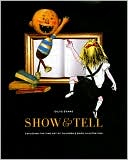
Book Review 3 - Genre 1 - Show and Tell: Exploring the Fine Art of Children's Book Illustrations by Dilys Evans

Bibliography -
Evans, Dilys. 2008. Show and tell: Exploring the fine art of children's book illustrations. ISBN 9780811849715.

Plot Summary -
Realizing a need to have universal vocabulary in which to discuss the fine art in children's books, Dilys Evans explores some of the best children's books to develop this vocabulary and to explain how the illustrations qualify as fine art. She selects a wide variety of illustrators who are diverse in styles, techniques and content. The twelve illustrators that she showcases are Hilary Knight, Trina Schart Hyman, Harry Bliss, David Shannon, Bryan Collier, Paul O. Zelinsky, Petra Mathers, Brian Selznick, David Wiesner, Betsy Lewin, Denise Fleming, and Lane Smith.

Critical Analysis -
While Evan's desire is to create a universal vocabulary to discuss fine art in children's books, she also has the expertise to accomplish the goal. She is a past art director for Cricket magazine, an accomplished author, adviser for Caldecott committees, and has worked with some highly acclaimed children's book illustrators. Additionally, in 1980 she founded The Original Art, an annual exhibition in New York featuring the best of children's book illustration of the year. She is uniquely qualified to take on this challenge.

The format for her book is the exploration of twelve contemporary illustrators of children's books. She looks at each illustrator separately and gives in-depth details on their life, influences in their art, chronology of their artistic career and a thorough explanation of the illustrator's individual artistic style. After reading this book, the reader has a complete understanding of how illustrations complement and enhance the text of a story. Page 125 offers an excellent example of the depth of her explanations. There she shows photographic images to support her written explanation of Denise Fleming's use of "pulp painting." Evans has masterfully created a book that will be a must have for librarians and anyone else who has a desire to learn more about the world of fine art in children's books.

Review Excerpts -
School Library Journal (starred review) - "Who better to 'show and tell' how children's book illustrators work their magic than Evans, whose life mission has been to advocate for their status as fine artists."
Booklist - "This attractive title will be a boon for librarians, teachers, students, and anyone else who wants to learn to look at and talk about the art in children's books, as well as better understand the stories behind the pictures."

Connections -
*
Share children's books by illustrators showcased in the book. Then share what Show and Tell: Exploring the Fine Art of Children's Book Illustrations says about the illustrator and his/her style. Discuss.
*After exposing children to stylistic descriptions of an illustrator and sharing a book by that illustrator have the children try the artistic style for themselves. Be sure to emphasize that the goal is not to create something "perfect," but to experiment and explore a particular style of art.
*Use Show and Tell: Exploring the Fine Art of Children's Book Illustrations to introduce children to the vocabulary necessary to discuss fine art in children's books.
*For older children, use Show and Tell: Exploring the Fine Art of Children's Book Illustrations to conduct research o contemporary children's book illustrators.

Book Review 2 - Genre 1 - Bebe Goes Shopping by Susan Middleton Elya


Bibliography -
Elya, Susan Middleton. 2008. Bebe Goes Shopping. Ill by Steven Salerno. Orlando: Harcourt, Inc. ISBN 9780152061425.

Plot Summary -
In this story, Mama negotiates the challenges of taking Bebe to the grocery store. Being a very young child, he is extremely curious about his surroundings, and the exploration of his curiosities makes challenges for Mama. Her shopping is continually interrupted by rescuing Bebe from his explorations, so she decides to give him a treat to eat to keep him busy. It is a day of wonder and excitement for Mama and Bebe.

Critical Analysis -
This active and engaging story is one to which both adult and child can relate. All mothers and children have experienced the busyness and wonder that a trip to the grocery store can hold. Inventive rhyme schemes are created using English to English words, Spanish to Spanish words and Spanish to English words. An example of Spanish to English words rhyming is "Por favor" rhyming with "floor". This makes for intriguing word play. This is an excellent book to share with children especially those who maybe learning English or to expose non-Spanish speakers to the Spanish language. All of the Spanish words are in bold print which focuses the reader's attention onto them. The glossary is a wonderful support for non-Spanish speakers to help with the meaning and correct pronunciation of the Spanish words.

The illustrations are drawn by Steven Salerno using gouache, watercolors, colored inks and colored pencils on French Arches 260 lb hot pressed watercolor paper. The drawings are larger than life and filled with bright colors. The people are drawn in very interesting ways. The head are proportionally larger than the bodies and oblong in shape which make them resemble no particular group. While the book uses Spanish words, the characters do not look particularly Spanish with the possible exception of the Senora who has some stereotypical features. The characters are brown in skin tone but culturally indistinct in features. Mama for example has crown shaped lips and a wide nose that could suggest African heritage. She also has almond shaped eyes that could suggest Asian heritage. While the book focuses on Spanish culture, the characters could fit into other cultural stories. That helps bring children from different cultures into the story.

Review Excerpts -
Publishers Weekly (Starred review) - "This delightful tale turns an everyday chore into a lively adventure, brimming with entertainment and enjoyment for all."
Booklist (Starred review) - "Introducing a young child to Spanish has never been as attractive as in this shopping romp...Fantastico!"
School Library Journal - "Warm and engaging."
Kirkus Review - "Will leave readers smiling."
Parenting Magazine - best book of the year

Connections -
*
Other books reinforcing Spanish:
  • Weeks, Sarah. Counting Ovejas. ISBN 0689867506.
  • Elya, Susan Middleton. Bebe Goes to the Beach. Ill. Steven Salerno. ISBN 0152060006.
*Share nursery rhymes and children's poems that are in English and Spanish:
  • "Los Politos" = "Little Chickens"
  • Other examples can be found at www.mamalisa.com which include songs, MP3s, MIDI, and videos.

Saturday, June 12, 2010

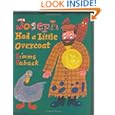
Book Review 1 - Genre 1 - Joseph Had a Little Overcoat by Simms Taback


Bibliography -
Taback, Simms. 1999. Joseph Had a Little Overcoat. New York: Penguin. ISBN 9780670878850.

Plot Summary -
In this cleverly designed picture book, Taback demonstrates recycling something (in this case a piece of clothing) until it is all used up and even then shows how something can be made out of nothing. This story was adapted from a Yiddish song which it closely follows.

Critical Analysis -
Taback mimics the lightheartedness of the Yiddish folk song, "I Had a Little Overcoat" in this picture book adaptation. He points out at the very beginning that this story is meant to have a moral, and the moral is "You can always make something out of nothing." As the reader moves from page to page curiosity is aroused in the anticipation of each transformation of the coat. This is a great read aloud selection which can allow for children to participate by predicting what article of clothing the item will become next. This humorous tale unfolds not only in the words, but also in the accompanying illustrations.

Besides writing the story, Taback also illustrates it. The illustrations are unique and captivating. He uses a combination of watercolor, gouache, pencil, ink and collage. He masterfully uses die-cut holes to show the next item Joseph makes from the piece of clothing. When the reader begins to turn the page, the shape of the die-cut gives a hint as to the next transformation of the item. Taback's use of color is very interesting. He uses mostly dark shades of primary colors with the edges of each page framed in black. The framing draws the reader directly into the pictures themselves wit all their vividness.

All of the illustrations reflect his cultural experiences for the most part. Each page is abundantly filled with extras to explore. For example on the page where Joseph visits his sister in the city, a wonderful collage of faces appears with each face in a different window representing wide cultural diversity - just as one might expect to find in a large city. Also on several pages, there are framed tapestries that are not only decorative but give a proverb. One reads, "Better to have an ugly patch than a beautiful hole," and my personal favorite, "If a pauper eats a chicken, one of them is sick." Each page is loaded with treasures to find.

Review Excerpts -
Publishers Weekly: "this is tailor-made for reading aloud. All ages."
Caldecott Medal Book
Parents Choice Gold Award
School Library Journal:
"Pre-Gr 3 - A book bursting at the seams with ingenuity and creative spirit."

Connections -
*Before reading the book, ask the children if they have ever made a piece of clothing into something else like pants cut off to make shorts.
*Share other books written and/or illustrated by Simms Taback like:
-There Was an Old Lady Who Swallowed a Fly
-This is the House That Jack Built
-Too Much Noise
-Road Builders
-Colors
*
Since the book deals with recycling a piece of clothing, have the children find out more about recycling and ways they can recycle in their community.
*Additional children's books on recycling:
-Roca, Nuria. The Three R's: Reuse, Reduce, Recycle (What Do You Know About?). ISBN 0764135813.
-Inches, Alison. The Adventures of a Plastic Bottle: A Story About Recycling. ISBN 1416967885.
-Inches, Alison. I Can Save the Earth: One Little Monster Learns to Reduce, Reuse, and Recycle. ISBN 1416967893.


Saturday, November 21, 2009

Internet Competency

By using Ask.com, I found Virtual Middle School Library Web site which is conveniently accessible 24 hours a day. Linda Bertland, a retired school librarian, maintains this site. She keeps it quite current. I accessed the site on November 20, 2009 and the last update of the site was on November 16, 2009. This Web site contains many useful links for anyone who has a connection with middle school. There are kid-friendly sites for reading interest and research. There are links of specific interest to parents, teachers, and librarians. The Web site address is http://www.sldirectory.com/virtual.html

Tuesday, November 17, 2009

Competency #8 Research Visual


It is important that middle school librarians are aware of emerging technologies like social networking, and how prevalent they are becoming in library/media centers. The chart above is part of a longitudinal study conducted by the American Association of School Librarians which was completed in 2008. The graph shows the social networking types supported by library media programs who responded to the survey. Intranet, blog, and wikis lead the way. Many believe that there will be an increase in usage for social networking in school libraries and are anxiously awaiting the 2009 results. The full report can be view at http://www.ala.org/ala/mgrps/divs/aasl/researchandstatistics/slcsurvey/slcsurvey.cfm

Monday, November 16, 2009

Competency #6 Project Muse Database

This is the final database for my database searching competencies.

Database: Project Muse

Research Question:
What is the correlation (if any) between technology rich school libraries/media centers and student achievement?

Search Strategy: Building Block

1. I logged into the database Project Muse and entered the search terms:
"technology" and "learning"

Results: 6993 records were retrieved- I must reduce my recall and get higher precision.

2. I searched within the 6993 records adding the term:
"media center"

Results: 2000 records were retrieved - I need to continue to narrow my results.

3. I searched within the 2000 records by adding the term:
"relationship"

Results: 1384 records were retrieved - I still need higher precision.

4. I searched within the 1384 records by adding the term:
"K-12"

Results: 70 records were retrieved. I reviewed these records by reviewing the brief description provided by the database. I discovered 6 records that warranted further investigation. Upon a full review of these 6 records, I found no information that I had not found in previous searches.

Reflections:

I think the "search within these results" feature is highly beneficial when attempting to receive precise information. It makes the building block strategy an excellent strategy to use with this particular database. Since I have been conducted other searches in other databases, this particular venture was not as fruitful as others I have done; however, I believe this would have made a productive starting place.